If you’ve lived in Elgin for more than a few years, you’ve probably noticed the white crust around your faucet aerators, the filmy residue on your shower glass, or your water heater groaning a little louder every winter. That’s not a coincidence. Elgin’s municipal water supply runs between 15 and 25 grains per gallon (GPG) of dissolved minerals— mostly calcium and magnesium —which puts it squarely in the “very hard” category. Elgin hard water plumbing problems are real, they’re measurable, and they cost homeowners money in ways that don’t always show up until something fails. This post gives you the honest picture: what scale actually does, what it costs, and what your real options are — including doing nothing.
What 15–25 GPG Actually Means (and How to Test It Yourself)
Water hardness is measured in grains per gallon. One grain equals about 17.1 milligrams of calcium carbonate per liter. The U.S. Geological Survey considers anything above 10.5 GPG “very hard.” Elgin’s water consistently lands between 15 and 25 GPG depending on the season and which part of the distribution system you’re on — that’s roughly 1.5 to 2.5 times the threshold for “very hard.” For context, Chicago’s Lake Michigan water comes in around 8–10 GPG. Elgin draws from groundwater sources that pick up significantly more mineral content on the way to your tap.
You can get a rough confirmation right at home. Buy a basic water hardness test strip kit — they’re available at hardware stores for a few dollars — and run your cold tap for 30 seconds before dipping the strip. If you’re in the 15–25 GPG range, the strip will show a deep color change. For a more precise reading, the Illinois Department of Public Health has resources on water quality testing labs, or you can request a consumer confidence report from the City of Elgin’s water utility, which publishes annual water quality data. The test won’t surprise most Elgin homeowners—but seeing the number in writing tends to make the downstream costs feel much more real.
The minerals themselves aren’t a health hazard. Calcium and magnesium are benign at these levels. The problem is purely mechanical: when hard water heats up or sits still, those dissolved minerals precipitate out and form scale — a hard, chalky deposit that coats the inside of pipes, heating elements, valve seats, and cartridges. The hotter the water, the faster it happens.
What Scale Does to a Standard Tank Water Heater
This is where the real money goes. In a tank water heater, cold water sits at the bottom of the tank near the burner or heating element. That’s exactly where scale accumulates fastest. Over time — and in Elgin’s water, “over time” means faster than the national average — you build up a layer of mineral sediment on the tank floor and around the heating element.
That sediment layer acts as insulation between the burner and the water. Your water heater has to work harder and run longer to reach the same temperature. You’ll hear it as a popping or rumbling sound when the burner fires — that’s water trapped under the sediment layer boiling and pushing through. It’s not dangerous, but it’s a sign the unit is working overtime.
Here’s what that costs in real terms:
- Energy efficiency: The U.S. Department of Energy estimates that scale buildup of just ¼ inch can reduce water heater efficiency by 40%. In Elgin’s water, you can reach that thickness in 3–5 years without flushing.
- Shortened lifespan: A tank water heater in soft-water areas often lasts 12–15 years. In hard-water markets like Elgin, 8–10 years is more realistic without maintenance. Some units fail at 6–7 years when scale is severe.
- Anode rod consumption: The sacrificial anode rod that protects your tank from corrosion depletes faster in hard water. A rod that might last 4–5 years elsewhere may need replacement in 2–3 years here.
Annual flushing — draining a few gallons from the tank drain valve to clear loose sediment — slows this down. It won’t reverse existing scale, but it buys time. If your water heater is already rumbling and it’s past the 8-year mark, flushing alone probably won’t save it. Our water heater repair and installation service includes an honest assessment of whether a flush and tune-up makes sense or whether you’re throwing good money at a unit that’s already on borrowed time.

Tankless Water Heaters and Hard Water: The Part the Brochure Skips
Tankless water heaters are genuinely excellent — but they have a specific vulnerability in hard-water markets that doesn’t always make it into the sales conversation. Because a tankless unit heats water on demand by running it through a narrow heat exchanger at high temperature, it concentrates scale formation in a very small space. The heat exchanger passages are tight by design. Scale narrows them further.
Left unaddressed, scale buildup in a tankless unit causes:
- Reduced flow rate (the unit starts to feel like it’s “running out” of hot water)
- Error codes and nuisance shutdowns as the unit overheats trying to compensate
- Heat exchanger failure — which is the most expensive repair on a tankless unit, often running $500–$900 in parts alone
The fix is descaling: a licensed plumber isolates the unit and circulates a food-grade descaling solution (typically diluted white vinegar or a commercial citric acid solution) through the heat exchanger for 45–60 minutes. In Elgin’s water, most manufacturers and plumbers recommend doing this every 12–18 months. Some homeowners in the 20–25 GPG range need it annually.
This isn’t a reason to avoid tankless — the energy savings and lifespan advantages are real. But if someone sold you a tankless unit without mentioning descaling in Elgin’s water, you now know what to budget for. Our tankless water heater installation and repair service includes descaling as a routine maintenance option, and we’ll tell you honestly how often your unit needs it based on your actual water hardness and usage.

Fixtures, Cartridges, and the Slow Seizure You Don’t See Coming
Scale doesn’t just attack your water heater. It works on every fixture in your home, just more slowly and less dramatically — until it isn’t slow anymore.
Faucet aerators are the most visible casualty. The small screen at the tip of your faucet collects mineral deposits and eventually restricts flow to a trickle or sprays water sideways. Cleaning or replacing an aerator is a five-minute job, but if you’re doing it every few months, that’s a signal of what’s happening deeper in the fixture.
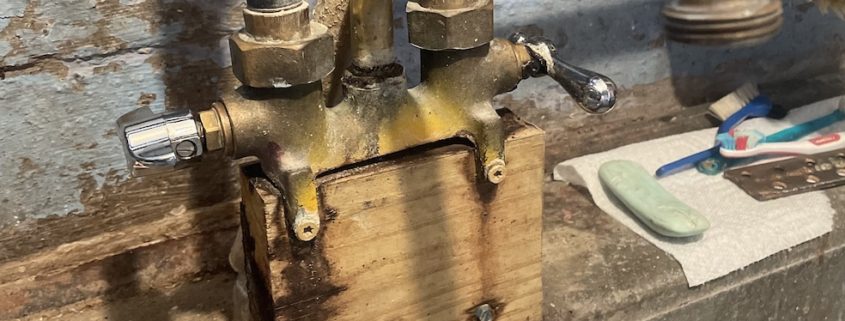
Cartridges and valve seats are where hard water gets expensive. The cartridge inside a single-handle faucet or shower valve controls hot/cold mixing and flow. In hard water, mineral deposits work into the cartridge mechanism, causing it to stiffen, stick, or fail to seal. You’ll notice it as a faucet that’s hard to turn, a handle that won’t shut off completely, or a drip that appears out of nowhere. Replacing a cartridge runs $75–$200 in labor and parts depending on the brand. In Elgin’s water, cartridges that might last 10–15 years in softer markets often need replacement in 5–8 years.
Showerheads clog with scale in the nozzle openings, producing uneven spray patterns. Soaking the head in white vinegar overnight dissolves light deposits. Heavier buildup means replacement.
Toilet fill valves and flappers are also affected. Scale on the flapper seat prevents a clean seal, causing the toilet to run continuously — wasting hundreds of gallons per month and wearing out the fill valve faster. If your toilet runs intermittently and a new flapper didn’t fix it, scale on the seat is often the culprit.
For fixture repairs and replacements, our faucet and fixture service covers everything from cartridge swaps to full fixture replacement — and we’ll tell you whether the fixture is worth saving or whether the hard water has already compromised it past the point of a simple repair.
Your Honest Options (Including Doing Nothing)
This is the part most plumbing content skips because it doesn’t sell anything. Here’s the real menu:
Option 1: Do Nothing
If your water heater is relatively new, your fixtures are in good shape, and you’re not noticing symptoms, doing nothing right now is a legitimate choice. Just know what you’re accepting: a shorter appliance lifespan, higher energy bills as efficiency drops, and more frequent fixture repairs. Budget accordingly. If your water heater is under 5 years old and you’re flushing it annually, you’re probably fine for a few more years.
Option 2: Maintenance Without a Softener
Annual water heater flushing, periodic descaling of a tankless unit, and replacing aerators and cartridges on a schedule cost far less than premature appliance replacement. This is the minimum-intervention approach, and it works reasonably well for homeowners who stay on top of it. The honest downside: it requires discipline, and most homeowners don’t flush their water heater until it fails.
Option 3: Point-of-Use Filters
Under-sink filters and showerhead filters reduce scale at specific fixtures but don’t protect your water heater or the rest of the system. They’re inexpensive and useful for drinking water quality, but they’re not a whole-house solution.
Option 4: Whole-House Water Softener
A salt-based ion-exchange softener is the most effective solution for protecting appliances and fixtures across the whole house. It genuinely extends water heater life, eliminates cartridge seizure, and stops scale in tankless heat exchangers. The tradeoffs: upfront cost ($800–$2,500 installed depending on system size), ongoing salt cost, and the fact that softened water adds a small amount of sodium to your water (relevant if you’re on a sodium-restricted diet). This post isn’t a softener sales pitch — we don’t sell softeners — but if you’re replacing a water heater for the second time in 10 years, the math on a softener starts to look different.
Option 5: Template Descalers / Salt-Free Conditioners
These devices claim to change the structure of calcium crystals so they don’t adhere to surfaces. The evidence is mixed. Some homeowners report improvement; controlled studies are less convincing. They’re not a scam, but they’re not a proven substitute for a salt-based softener either. If you’re considering one, go in with realistic expectations.
How to Know When Hard Water Has Already Won
There are a few clear signals that scale has progressed past the maintenance stage and you’re looking at repair or replacement:
- Your water heater is rumbling or popping loudly when it fires — sediment is significant
- Hot water recovery is noticeably slower than it used to be
- Your tankless unit is throwing error codes or cycling off during showers
- Multiple faucets in the house are dripping or hard to operate
- Your water heater is 8+ years old and has never been flushed
At that point, a service call makes more sense than another round of DIY. A licensed plumber can tell you in 20 minutes whether you’re looking at a flush-and-tune or a replacement — and give you a straight answer without upselling you on something you don’t need. That’s how we operate. You can learn more about our approach on our about page, or check out our service guarantee if you want to know what we stand behind.
For broader context on cross-connection and water quality standards in Illinois, the EPA’s drinking water resources are a solid reference. The American Water Works Association also publishes detailed guidance on water hardness and its effects on distribution systems and home plumbing. And This Old House has practical homeowner-level guides on water heater maintenance that align with what we recommend in the field.
Frequently Asked Questions
How do I know if my water heater failure was caused by hard water?
The clearest sign is sediment at the bottom of the tank when it’s drained — a thick, sandy or chalky layer that’s visible in the drain water. If your unit failed before the 10-year mark and you’re in Elgin, hard water is almost certainly a contributing factor. A plumber can also inspect the heating element (on electric units) for scale coating, which looks like a thick white crust. If you’re replacing a unit that failed early, it’s worth addressing the scale issue before the new unit goes in — otherwise you’re starting the same clock over again.
Can I descale my tankless water heater myself?
Technically yes, if you’re comfortable with plumbing connections and have the right equipment — isolation valves, a small pump, and food-grade descaling solution. The process involves isolating the unit, connecting a pump to circulate the solution through the heat exchanger, running it for 45–60 minutes, then flushing with clean water. The risk in doing it yourself is incomplete flushing (leaving descaling solution in the unit) or improper reconnection. Most homeowners find it easier and safer to have a licensed plumber handle it, especially the first time. We can also check the unit’s condition while we’re there and catch anything else that needs attention.
Does hard water affect my pipes, or just the fixtures and appliances?
It depends on the pipe material. Copper pipes can develop scale buildup on the interior walls over decades, gradually reducing flow — but this is a very slow process and rarely causes problems in a typical residential lifespan. Galvanized steel pipes (common in Elgin homes built before the 1960s) are more vulnerable: scale accelerates corrosion and can significantly restrict flow in 20–30 years. PEX and CPVC pipes are largely unaffected by scale. The bigger concern with hard water is always the appliances and fixtures, not the pipes themselves — unless you have older galvanized plumbing.
Is Elgin’s hard water safe to drink?
Yes. The calcium and magnesium that cause hardness are not health hazards at the levels found in Elgin’s water supply. The City of Elgin publishes an annual water quality report that confirms compliance with all EPA drinking water standards. Hard water can affect taste — some people find it slightly mineral-tasting — but it poses no health risk. The concern is entirely mechanical: what those minerals do to your plumbing, appliances, and fixtures over time.
How often should I flush my water heater if I’m in Elgin?
Once a year is the standard recommendation, and in Elgin’s 15–25 GPG water, that’s not conservative — it’s genuinely necessary. If your unit has never been flushed and it’s more than 3–4 years old, start carefully: heavy sediment can sometimes dislodge and clog the drain valve during the first flush. If you’re not comfortable doing it yourself, a plumber can flush it as part of a routine service call. Annual flushing won’t eliminate scale, but it removes loose sediment before it compacts and hardens on the tank floor.
The Bottom Line
Elgin’s hard water isn’t going anywhere, and it’s not a crisis — but it is a real variable in how long your plumbing equipment lasts and how much you spend maintaining it. A water heater that should last 12 years might give you 8. A tankless unit that runs flawlessly in softer markets needs descaling here every 12–18 months. Fixture cartridges seize up faster. None of this is catastrophic, but all of it adds up, and most of it is preventable with the right maintenance schedule.
If you’re hearing your water heater rumble, dealing with fixtures that won’t cooperate, or just want a straight answer on where your system stands, give us a call. We’re licensed Master Plumbers — IL #058-161084 — and we’ve been working in Elgin’s water for over 15 years. We’ll tell you what we actually find, not what sells the most parts. Schedule a service call online or call us directly at (847) 624-3872. No pressure, no upsell — just an honest look at what Elgin’s water is doing to your plumbing.