
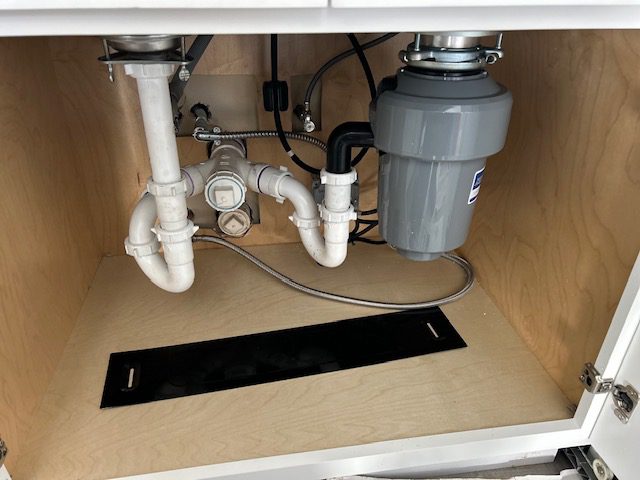
It’s 10 a.m. on Thanksgiving. You’ve got a 14-pound turkey in the oven, your mother-in-law arrives at two, and your garbage disposal just made a sound like a blender full of gravel — and stopped. Now it won’t turn on. The sink is backing up. And you have no idea whether to call a plumber or just keep hitting the reset button. If that’s where you are right now, take a breath. This post walks you through the most common disposal problems, what you can safely fix yourself in the next 20 minutes, and what’s going to need a licensed plumber before your kitchen turns into a bigger mess than it already is. We do garbage disposal repair in Elgin and across the Fox Valley year-round — and yes, we’re available on holidays.
Why Thanksgiving Is the Worst Day for Your Garbage Disposal
Thanksgiving puts more stress on a residential kitchen drain system than almost any other day of the year. The American Society of Plumbers and Drain Cleaners has a name for the Friday after Thanksgiving — “Brown Friday” — because it’s consistently one of the busiest emergency plumbing call days of the year. That’s not a coincidence. It’s the direct result of what goes down the drain the day before.
Here’s what actually happens: a normal household disposal handles maybe a few cups of soft food scraps per day. On Thanksgiving, it gets hit with potato peels, celery strings, turkey skin, cooking grease, and whatever’s left on six dinner plates — all in the span of about 45 minutes. The motor overheats. The grinding plate jams. The drain line, already moving slowly because of Elgin’s hard water deposits, backs up completely.
The good news is that most Thanksgiving disposal failures follow a predictable pattern, and a lot of them have a fix you can do yourself before the guests arrive. The bad news is that some of them don’t — and waiting until Friday to call a plumber means you’re cooking in a kitchen with a backed-up sink.
The Four Things Most Likely to Kill Your Disposal Today
1. Potato Peels
This is the number-one Thanksgiving disposal killer, and it surprises people every year. Potato peels are thin enough to slip past the grinding plate without getting shredded — they wrap around the impeller and create a starchy paste that sets up like concrete. A full bag of potato peels can jam a disposal in under two minutes. Peel your potatoes over the trash can, not the sink.
2. Cooking Grease and Turkey Fat
You already know not to pour hot grease down the drain. But here’s the part people miss: even small amounts of turkey drippings rinsed off a pan will coat the inside of your drain line. Hot water doesn’t dissolve grease — it just moves it a few feet downstream, where it cools, solidifies, and starts narrowing the pipe. Do this enough times and you’ve got a grease clog that a plunger won’t touch. Let the grease cool in the pan, scrape it into a can, and throw it away.
3. Celery, Artichokes, and Fibrous Vegetables
The stringy fibers in celery, asparagus, and artichoke leaves don’t grind — they wrap. They tangle around the disposal’s impeller shaft the same way hair wraps around a vacuum brush. A handful of celery stalks can bring a disposal to a complete stop. Compost or trash these; they don’t belong in the disposal.
4. Too Much, Too Fast
Even if you’re putting in the right stuff, volume and speed matter. A disposal is designed to handle small amounts of soft food waste with cold water running continuously. When you scrape an entire plate in at once and run it for 10 seconds, you’re asking the motor to do in one burst what it’s designed to do over several minutes. Feed it slowly, run cold water the whole time, and keep running the water for 30 seconds after you turn the disposal off.
Disposal Won’t Turn On? Try These Steps Before You Call
If your disposal is completely dead — no hum, no noise, nothing — there’s a good chance it tripped its own thermal overload protector. This is a built-in safety feature that cuts power when the motor overheats. Here’s the sequence to try:
- Turn the disposal switch off. Make sure it’s in the off position before you do anything else.
- Wait 10–15 minutes. The motor needs to cool down. Don’t skip this step.
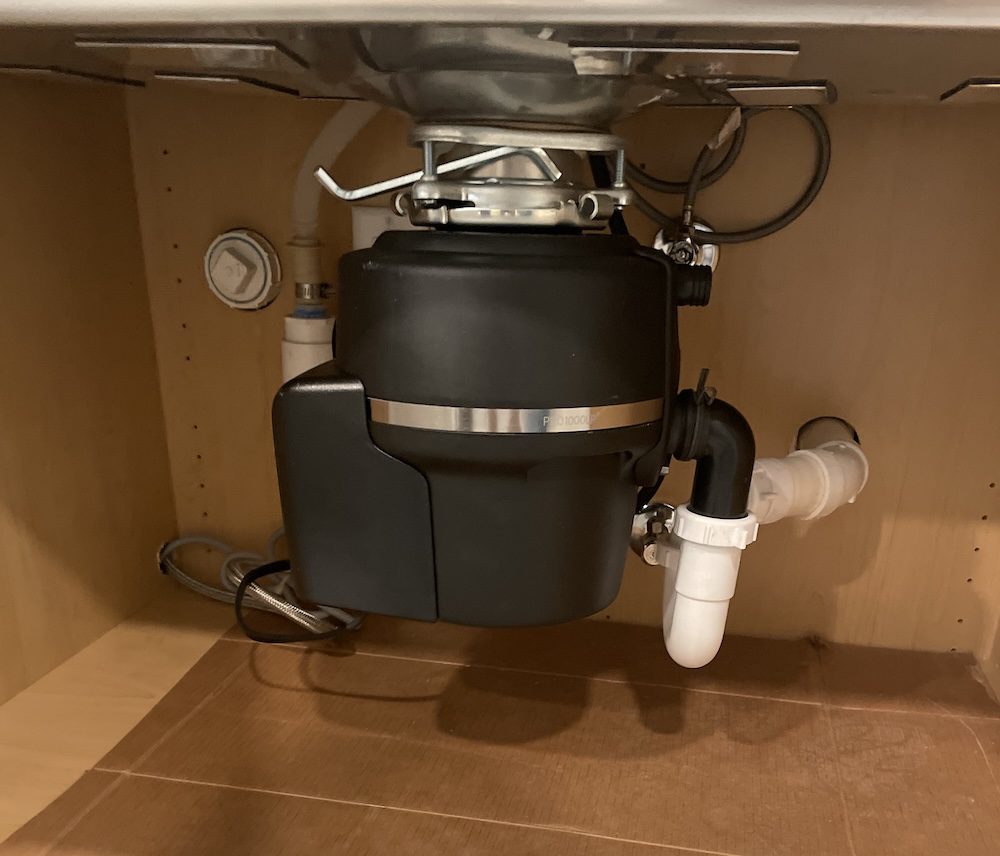
- Press the red reset button. It’s on the bottom of the disposal unit, under the sink. You’ll feel it click when it resets. If it doesn’t click, the motor is still too hot — wait longer.
- Run cold water and turn it back on. If it hums but doesn’t spin, you have a jam (see below). If it’s still completely silent, the problem is electrical or the motor is burned out.
If It Hums But Won’t Spin — Clear the Jam
A humming disposal that won’t turn is a jammed impeller. Turn the switch off immediately — running a jammed motor will burn it out fast. Most disposals come with a hex wrench (usually 1/4-inch) that fits a socket on the bottom of the unit. Insert it and work it back and forth to free the jam. If you don’t have the wrench, a standard Allen key from a hardware store works. Once you feel it break free, remove whatever was jamming it with tongs — never your hand — then reset the button and try again.
If you’ve done all of this and the disposal still won’t run, or if it runs but the sink is still draining slowly, the problem has moved downstream. That’s a drain line issue, not a disposal issue — and that’s where DIY stops being safe.
When the Sink Backs Up: What’s Actually Happening in Your Drain Line
A backed-up kitchen sink on Thanksgiving usually means one of three things: a clog in the P-trap directly under the sink, a partial blockage in the branch drain line, or — the one nobody wants to hear — a problem in the main sewer line. The first two are common and fixable same-day. The third one means water is going to start backing up in other drains around the house, and that’s a plumbing emergency.
Here’s how to tell the difference: if only the kitchen sink is slow or backed up, you’re probably dealing with a localized clog. If you flush a toilet and water gurgles up in the kitchen sink, or if your basement floor drain is wet, you’ve got a main line problem. Stop using water immediately and call us. A main sewer line backup on Thanksgiving afternoon is not something to wait on.
For a localized kitchen clog, a plunger can sometimes clear a P-trap blockage. Use a cup plunger (not a flange plunger, which is for toilets), cover the other drain opening if you have a double sink, and give it 10–15 firm strokes. If the water drains, run hot water for a few minutes to flush the line. If it doesn’t clear after two attempts, stop. Repeated plunging can loosen drain connections under the sink, and chemical drain cleaners like Drano are hard on pipes and almost never fix a real grease clog — they just create a different problem. Our kitchen drain cleaning service uses professional-grade equipment that actually removes the blockage instead of pushing it further down the line.
How Hard Water Makes This Worse in Elgin
If you’ve lived in Elgin for more than a few years, you’ve seen the white mineral buildup on your faucets and showerheads. Elgin’s municipal water runs between 15 and 25 grains per gallon — that’s genuinely hard water, and it affects your drain lines the same way it affects everything else. Over time, calcium and magnesium deposits build up on the inside walls of your kitchen drain pipes, narrowing the opening and giving grease and food particles something to stick to. A drain line that’s been in service for 10 or 15 years in an Elgin home may be running at half its original diameter inside.
This is why a kitchen that handled Thanksgiving fine three years ago suddenly can’t keep up. The disposal didn’t get weaker — the drain got narrower. High-pressure water jetting is the most effective way to clear mineral buildup and grease accumulation from drain lines, and it’s something we do regularly for Elgin homeowners who want to get ahead of this before the holidays rather than deal with it during them.
The EPA’s drinking water guidelines don’t set a health limit on water hardness, but the American Water Works Association considers anything above 10.5 GPG “very hard” — Elgin’s water is well past that threshold, and it shows up in your plumbing over time.
What a Plumber Actually Does for a Disposal Repair or Replacement
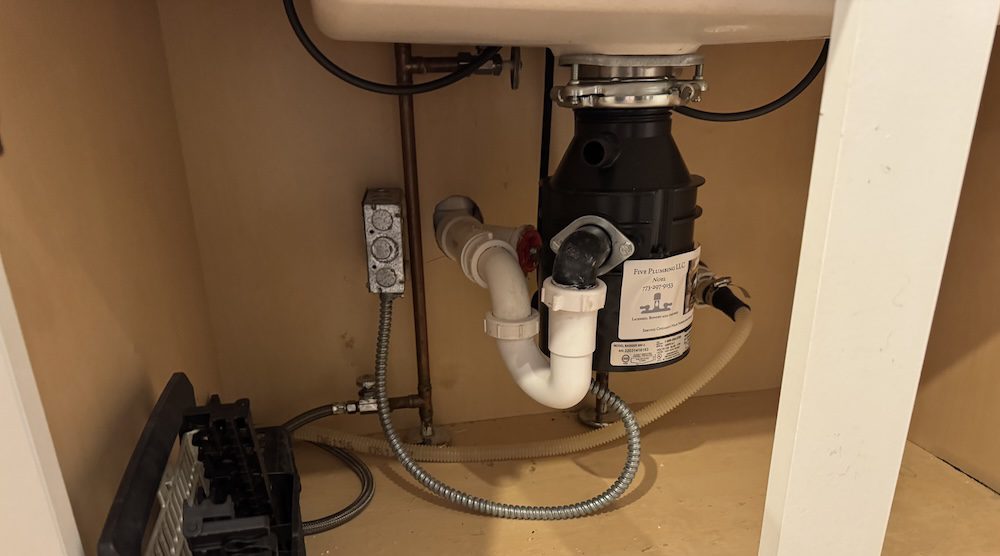
If the reset button and the hex-key trick don’t get your disposal running, or if it’s leaking from the bottom or the side, you’re looking at either a repair or a replacement. Here’s what to expect when we come out.
First, we diagnose whether the problem is the disposal itself or the drain line. A disposal that hums but won’t clear after manual unjamming usually has a worn impeller or a failed motor — at that point, replacement is almost always more cost-effective than repair, especially on a unit that’s more than eight years old. A disposal that runs fine but the sink still drains slowly means the clog is downstream, and we’ll use a drain snake or hydro-jetting to clear it.
Disposal replacement is a straightforward job — usually under two hours — and we carry common residential units on the truck. We’ll also check the drain line connection and the P-trap while we’re under there, because a disposal failure and a slow drain often share the same root cause. Illinois plumbing work is governed by Illinois Department of Public Health licensing requirements under 225 ILCS 320, and every job we do is performed by a licensed Master Plumber. Our license number is IL #058-161084 if you want to verify it.
For homeowners who want to understand what goes into a proper installation, This Old House has solid reference material on disposal sizing and installation standards — though for anything beyond a basic reset, a licensed plumber is the right call.
What to Do Right Now If You’re Mid-Crisis
If your disposal is jammed and the sink is backing up and you’ve got guests arriving in three hours, here’s the short version:
- Turn off the disposal switch. Don’t run it again until you’ve cleared the jam.
- Try the reset button on the bottom of the unit after waiting 15 minutes.
- If it hums but won’t spin, use the hex key on the bottom socket to free the jam manually.
- If the sink is backed up, try a cup plunger — 10–15 strokes, not more.
- If none of that works, or if water is backing up in other drains, stop and call us.
You can also do a lot of the cooking prep differently today: peel vegetables over the trash, scrape plates into the garbage before rinsing, and keep the disposal off until after the meal when you can run it slowly with plenty of cold water. Your drain line will thank you.
And if you want to get ahead of this for next year, a professional kitchen drain cleaning in October or early November is one of the better investments an Elgin homeowner can make. We also offer a preferred customer membership that includes priority scheduling — which matters a lot when it’s Thanksgiving morning and you need someone fast.
Frequently Asked Questions
Can I use Drano or a chemical drain cleaner to clear a garbage disposal clog?
We’d strongly recommend against it. Chemical drain cleaners are caustic — they can damage the rubber components inside your disposal, corrode older metal drain pipes, and create a hazardous situation if the drain is fully blocked and the chemical sits in the pipe. They also rarely fix a real grease or food-waste clog; they just thin the outer layer and leave the core of the blockage in place. A drain snake or hydro-jetting actually removes the material. If you’re tempted to reach for a chemical cleaner, call us instead — it’ll save you money and protect your pipes.
My disposal is leaking from the bottom. Is that fixable or does it need to be replaced?
A leak from the bottom of the disposal unit — not from the drain connection or the sink flange, but from the body of the unit itself — almost always means the internal seal has failed. That’s not a repair; it’s a replacement. Internal seals aren’t serviceable on most residential units, and the cost of attempting a repair usually exceeds the cost of a new unit. A leak from the side connection or the drain outlet is a different story — that’s often just a loose fitting or a worn gasket, and it’s a quick fix. Tell us where the water is coming from when you call and we can give you a better sense of what you’re dealing with before we arrive.
How long should a garbage disposal last?
A quality residential disposal, properly used and maintained, typically lasts 10 to 15 years. If yours is past that range and starting to have problems — slow grinding, frequent jams, leaks, or a motor that trips the reset button regularly — replacement is almost always the better financial decision. Repairs on an aging unit tend to be a short-term fix. When we come out for a disposal call, we’ll give you an honest assessment of whether repair or replacement makes more sense for your specific unit and situation.
Is it okay to put turkey bones or small chicken bones in the disposal?
Small, soft bones — like the thin rib bones from a rotisserie chicken — are actually fine for most modern disposals and can help clean the grinding chamber. Turkey bones are a different story. They’re dense and large enough to damage the impeller or jam the unit entirely. Keep turkey carcasses, drumstick bones, and any large bones out of the disposal. When in doubt, the trash or a stock pot is the right destination.
The disposal works but my kitchen sink still drains slowly. What’s going on?
If the disposal is running fine but the sink drains slowly, the clog is downstream of the disposal — in the P-trap, the branch drain line, or further into the main drain stack. This is very common in Elgin homes because of hard water mineral buildup narrowing the drain pipes over time. A slow drain that’s been getting gradually worse over months is almost always a buildup issue, not a single clog. Our kitchen drain cleaning service can clear it, and high-pressure water jetting is the most thorough option for a drain line that’s been accumulating buildup for years.
If your garbage disposal is jammed, your kitchen sink is backed up, or you just want to make sure your drain lines are clear before the holiday rush, we’re here. Fox Valley Plumbing & Backflow has been handling garbage disposal repair in Elgin and across the Fox Valley for over 15 years — and we’re available 24/7, including holidays. Call us at (847) 624-3872 or schedule service online and we’ll get someone out to you fast. Don’t let a jammed disposal turn Thanksgiving into a plumbing emergency.




Leave a Reply
Want to join the discussion?Feel free to contribute!